In the world of automation and human-machine interfaces, NO (Normally Open) and NC (Normally Closed) contacts play a fundamental role. They are at the core of many industrial systems, whether for motor control, status signaling, or installation safety. Yet, the terms 1NO/1NC and 2NO/2NC can sometimes be unclear for designers or system integrators. At EOZ, we integrate them into our R.Series range to meet the demands of the most critical sectors. This article aims to clarify these concepts, highlight their differences, and explain their concrete applications.
But what do NO and NC mean ?


Understanding NO and NC Contacts
A Normally Open (NO) contact is, as its name suggests, open when at rest: current only flows when the user presses the button. Conversely, a Normally Closed (NC) contact is closed by default and only opens when activated. This simple distinction has major consequences in system design. In an industrial machine, for example, a start button almost always uses an NO contact, while an emergency stop button relies on an NC contact, ensuring that any circuit break immediately stops the installation.
The Difference Between 1NO/1NC and 2NO/2NC
When we talk about 1NO/1NC, we refer to a button equipped with one normally open contact and one normally closed contact, allowing two different functions to be managed simultaneously. A 2NO/2NC configuration, on the other hand, offers two open contacts and two closed contacts, used in parallel to control multiple circuits or provide redundancy. The main difference therefore lies in the level of safety and flexibility: 1NO/1NC is sufficient for standard control and signaling cases, while 2NO/2NC is preferred in environments where reliability is critical, such as medical, transportation, or defense applications.
Industrial Applications and Added Value
In industry, the 1NO/1NC configuration is often found in emergency stop systems, where the NO contact cuts off power and the NC contact informs the system of the button’s status. The 2NO/2NC configurations are more widely used in architectures requiring redundancy, for instance in automated production machinery where two independent circuits must be controlled simultaneously to comply with safety standards.
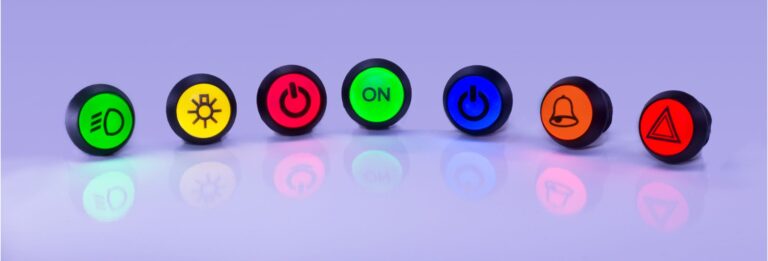
These multiple contacts also allow for more advanced scenarios, such as activating a command while triggering an indicator light—all with a single button. EOZ supports its clients in these use cases with the R.Series, which offers standard versions in 1NO, 1NC, and 1NO+1NC, as well as 2NO/2NC options available on request, tailored for the most demanding environments.
Learn more about the R.Series range
R.Series, a high-performance range
Discover all our available products.